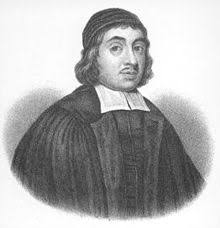
Thomas Watson
Thomas Watson (c. 1620-1686) was educated at Emmanuel College, Cambridge, where he was noted for remarkably intense study. In 1646 he was commenced a sixteen year pastorate at St. Stephen’s, Walbrook. He showed strong Presbyterian views during the civil war, with, however, an attachment for the king, and in 1651 he was imprisoned briefly with some other ministers for his share in Christopher Love’s plot to recall Charles II of England. He was released on June 30, 1652, and was formally reinstated vicar of St. Stephen’s Walbrook. He obtained great fame and popularity as preacher until the Restoration, when he was ejected for nonconformity. Notwithstanding the rigor of the acts against dissenters, Watson continued to exercise his ministry privately as he found opportunity. Upon the Declaration of Indulgence in 1672 he obtained a license for the great hall in Crosby House. After preaching there for several years, his health gave way, and he retired to Barnston in Essex, where he died suddenly while praying in secret. Wikipedia.
“There is a happy union of sound doctrine, practical wisdom, and heart-searching experience, throughout all of Watson’s writings!” (Spurgeon)
A Body of Divinity
.A Divine Cordial
. .A Treatise Concerning Meditation
.All for Good
.Art of Divine Contentment
.The Beatitutes
. .The Christian Charter
.The Christian Soldier
. .The Doctrine of Repentance
.The Duty of Self-Denial
.The Godly Man’s Picture
The Great Gain of Godliness
.The Lord’s Prayer
.The Mischief of Sin
. .The One Thing Necessary
.Pithy Gems
.Puritan Gems
.Roman Catholicism
.Ten Commandments
.Treasures from Thomas Watson
Wise and holy sayings of Thomas Watson
.Words of Wisdom…
.